How to Understand and Apply the New Testament: Twelve Steps from Exegesis to Theology by Andrew David Naselli
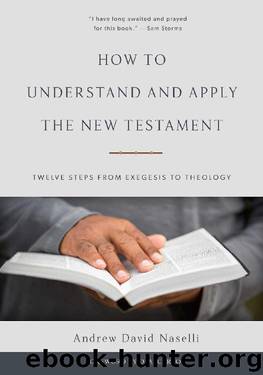
Author:Andrew David Naselli
Language: eng
Format: mobi, epub
ISBN: 9781629952505
Publisher: P&R Publishing
Published: 2017-03-07T16:00:00+00:00
7
LITERARY CONTEXT
UNDERSTAND THE ROLE THAT A PASSAGE PLAYS IN ITS WHOLE BOOK
What Are the Different Levels of the Literary Context?
“Love is patient and kind; love does not envy or boast; it is not arrogant or rude. It does not insist on its own way; it is not irritable or resentful.”
Have you heard those words before? They are Paul’s famous words from what people call the love chapter: 1 Corinthians 13. These words are 1 Corinthians 13:4–5.
But I suspect that most people don’t understand that passage’s literary context. There are several different levels of the literary context. Let’s walk through them:
1. Let’s start with the passage itself. The lines I quoted are clear enough. Paul describes love in nine ways. But if you look at only those words, then you might think that this passage applies primarily to a marriage, an intimate relationship that requires love in order for it to function well. Because so many people have chosen to read this passage during their wedding ceremonies, a lot of people think that this passage is talking about love between a husband and wife.
2. What happens if you zoom out a little bit and look at the immediate context—the paragraph before, the rest of this paragraph, and the next paragraph? It doesn’t sound like this passage is about marriage, does it? If you read just chapter 13, then you can discern at least that it’s emphasizing that love is preeminent in some way. By the way, did you catch that I referred to paragraphs? It’s crucial to think in paragraphs as you look at the immediate context and beyond.
3. What happens if you zoom out a little bit more and look at the section in which this chapter appears? It’s part of a larger section that includes chapters 12–14. Ah, now it starts to make more sense. The Corinthians had been abusing the gift of tongues, wrongly elevating it as more important than other gifts. So Paul argues in chapter 12 that all the diverse members of the unified body of Christ are important and that it’s foolish to elevate certain gifts, such as speaking in tongues, over other gifts in importance. Paul argues in chapter 14 that prophesying is greater than speaking in tongues because it edifies the whole church; the higher gifts edify the whole church and are intelligible and orderly. What is chapter 13 doing sandwiched in the middle? No matter what gift the Spirit enables you to use, it doesn’t profit you anything unless you do it in love. Love is essential, whether the Spirit empowers you to speak in tongues or prophesy or teach or whatever. That’s why chapter 14 begins: “Pursue love, and earnestly desire the spiritual gifts, especially that you may prophesy.” When reading 1 Corinthians, you should not pause between the end of chapter 13 and the beginning of chapter 14 because it is a single literary section: “So now faith, hope, and love abide, these three; but the greatest of these is love.
Download
How to Understand and Apply the New Testament: Twelve Steps from Exegesis to Theology by Andrew David Naselli.epub
This site does not store any files on its server. We only index and link to content provided by other sites. Please contact the content providers to delete copyright contents if any and email us, we'll remove relevant links or contents immediately.
| Guides | New Testament |
| Old Testament |
The Five People You Meet in Heaven by Mitch Albom(3549)
The Secret Power of Speaking God's Word by Joyce Meyer(3159)
Real Sex by Lauren F. Winner(3005)
Name Book, The: Over 10,000 Names--Their Meanings, Origins, and Spiritual Significance by Astoria Dorothy(2969)
The Holy Spirit by Billy Graham(2938)
0041152001443424520 .pdf by Unknown(2842)
How The Mind Works by Steven Pinker(2811)
ESV Study Bible by Crossway(2772)
Ancient Worlds by Michael Scott(2677)
Churchill by Paul Johnson(2576)
The Meaning of the Library by unknow(2563)
The ESV Study Bible by Crossway Bibles(2546)
The Gnostic Gospels by Pagels Elaine(2517)
MOSES THE EGYPTIAN by Jan Assmann(2411)
Jesus by Paul Johnson(2349)
City of Stairs by Robert Jackson Bennett(2337)
The Complete Dead Sea Scrolls in English (7th Edition) (Penguin Classics) by Geza Vermes(2269)
The Nativity by Geza Vermes(2222)
Ancient Near Eastern Thought and the Old Testament by John H. Walton(2219)
